
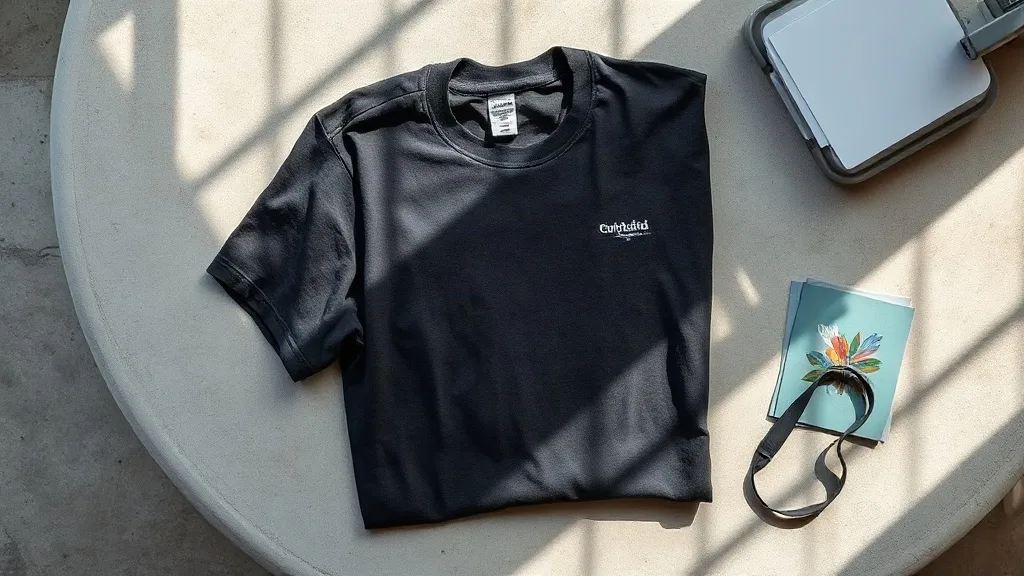
Most people who order dtf transfers for the first time are surprised by one thing: the print itself is rarely the problem. The failures we see come from the shirt, the press, or the way the two were introduced to each other. On a heavyweight cotton tee, where the fabric is thick, dense, and often garment-dyed, those small variables matter far more than they do on a thin poly blend. This guide is written from the production side of a wholesale heavyweight tee operation, so it focuses on what actually happens when you put a transfer onto a 6 oz or 7 oz cotton body and send it through real wear.
Why heavyweight cotton changes the DTF conversation
A standard 4.5 oz jersey and a 7 oz heavyweight tee are not the same substrate, even when both are 100% cotton. The heavier fabric has more mass, a tighter knit, and a surface that varies more from roll to roll. That matters because dtf film relies on a powder adhesive that melts into the fiber surface. On a thin, uniform knit, that bond is predictable. On a dense heavyweight body, the adhesive has to grip a surface that may be slightly hairy, brushed, or finished with a softener.
In practice, this means a transfer that presses perfectly on a lightweight blank can look slightly dull or sit a touch high on a heavyweight one. It is not a defect. It is the difference between pressing into a surface and pressing onto it. Once you understand that, you stop chasing the wrong fix.
Garment-dyed and enzyme-washed blanks need extra attention
Heavyweight tees are frequently garment-dyed, which gives them that broken-in look buyers love. Those same washes leave behind softeners and surface residue that can interfere with adhesion. If you press a transfer onto an unwashed garment-dyed tee without pre-pressing, you are essentially asking the adhesive to bond to whatever is sitting on top of the cotton rather than the cotton itself. A 5 to 10 second pre-press at the same temperature you plan to use for the transfer will drive off moisture and flatten the surface. It is the single cheapest step you can add to your process.
Press settings that hold up on thick cotton
There is no universal magic number, but there is a reliable starting range. For most heavyweight cotton tees, 320 to 340 degrees Fahrenheit, medium to firm pressure, and 10 to 15 seconds works well. The variables to adjust are pressure and time, not temperature. Raising temperature to force a bond is how you scorch fabric and create a stiff, plastic-feeling print.
- Pre-press the shirt: 5 to 10 seconds to remove moisture and smooth the surface.
- Peel cool or warm, not hot: hot peeling on dense cotton can stretch the film and leave a hazy edge.
- Second press with a cover sheet: 5 seconds to settle the adhesive into the knit.
- Let the shirt rest flat: at least a few minutes before folding, so the bond sets without stress.
Pressure is where most home setups fall short. A press that closes with a light touch will not push the adhesive into a 7 oz cotton surface. If your prints feel slightly raised and wash out early, increase pressure before you touch the temperature dial.
Cold peel versus hot peel on dense fabric
Cold peel is generally safer on heavyweight cotton because it lets the adhesive cool and lock before you pull the carrier away. Hot peel is faster and works beautifully on smooth, thin fabrics, but on a thick knit the film can drag slightly as it lifts. If you are producing at volume and need speed, test hot peel on one blank from each colorway before committing. A single test shirt costs you a few minutes; a batch of 200 with lifted edges costs you a reprint.
What wash durability really depends on
Everyone asks how many washes a dtf transfers print will survive. The honest answer is that it depends on four things: adhesive quality, press pressure, fabric finish, and how the garment is washed. A well-pressed transfer on a quality heavyweight tee will typically outlast the shirt's own shape. A poorly pressed one can start to lift after three cycles.
Wash testing is the only way to know for your specific combination. Take three pressed shirts, wash them inside out in cold water, tumble dry low, and inspect after 1, 5, and 10 cycles. Look at the edges, not the center. Edge lift is the earliest warning sign, and it tells you whether pressure or peel temperature needs adjustment.
The detergent trap
Fabric softener and pods with built-in softeners are hard on any heat-applied decoration. They leave a film on the print surface that gradually dulls it and can work under the edges. If your customers are heavy softener users, mention cold wash and inside-out drying on the hang tag. It is a small nudge that protects your work.
Choosing artwork that suits heavyweight tees
Heavyweight cotton has a visible texture, and that texture interacts with design choices. Fine one-color line work can get lost in the knit. Large solid blocks of white ink look heavier and more opaque on a thick shirt than on a thin one, which is usually a good thing. Halftones and soft gradients need a higher mesh equivalent in the file to survive the fabric weave.
From a wholesale perspective, the strongest sellers on heavyweight bodies tend to be bold, high-contrast graphics with clean edges. They photograph well, they read from a distance, and they hide the minor surface variation that thick cotton always has. If you are building a collection, lead with those and treat delicate detail work as a secondary line.
Ordering transfers at wholesale volume
When you are buying transfers by the hundred rather than the dozen, a few checks save real money. Confirm the gang sheet layout before production so you are not paying for wasted film. Ask how the supplier handles color matching across a reorder, since a second run of the same design can drift. And always press a sample from the actual delivered batch, not from a previous order, because film and powder lots do vary.
It also helps to standardize your blanks. If your heavyweight tee program uses two or three consistent bodies, you can dial in one press recipe per body and stop guessing. Consistency in the shirt is what makes consistency in the print possible.
Frequently asked questions
Can DTF transfers be applied to 100% heavyweight cotton?
Yes, and heavyweight cotton is one of the better substrates for it. The dense surface holds the adhesive well once the fabric is pre-pressed and enough pressure is applied. The main adjustment compared with lightweight blanks is a slightly longer press and firmer pressure.
Do DTF prints feel stiff on thick tees?
They have a light hand that most wearers notice only on very large solid areas. On a heavyweight shirt, the fabric itself is substantial, so the print feels proportionate. Keeping ink coverage reasonable and avoiding oversized solid blocks will keep the drape comfortable.
How long should I press a DTF transfer on a 7 oz tee?
Start at 320 to 340 degrees Fahrenheit for 12 to 15 seconds at medium to firm pressure, then do a 5 second second press with a cover sheet. Test one shirt from each colorway and adjust time or pressure based on edge adhesion after washing.
Why is my transfer lifting at the corners after washing?
Corner lift almost always points to insufficient pressure or a hot peel that stretched the film. Pre-press the garment, increase pressure, and peel cool. If the problem continues, check whether the blank has a heavy softener finish that needs a longer pre-press.
Can I mix DTF with other decoration on the same shirt?
You can, but sequence matters. Apply heat-sensitive decorations first and press the transfer last, or use lower temperature settings for the second application. Always test the combination on a scrap shirt before running a batch.