
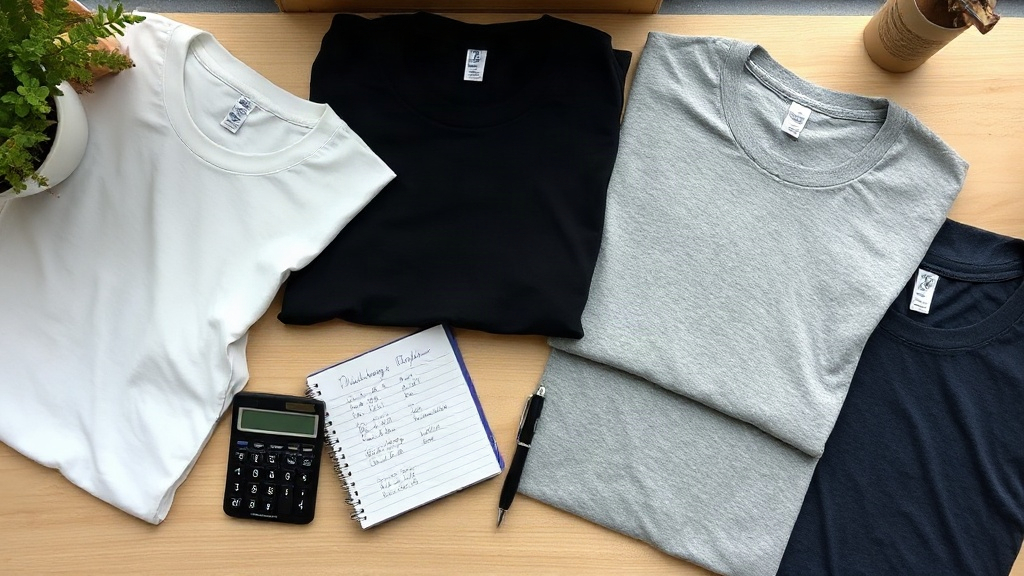
When you order custom premium t-shirts, the price you see per shirt rarely tells the whole story. Smart buyers focus on CPS (cost per shirt), a metric that reveals the true cost of your order after factoring in setup fees, shipping, and extras. Understanding CPS helps you compare quotes accurately, avoid hidden charges, and maximize value for your budget. Whether you're outfitting a team, promoting a brand, or creating merchandise, knowing how to calculate and optimize CPS is essential for getting premium quality without overpaying.
What Is CPS and Why It Matters for Custom Premium T-Shirts
CPS stands for cost per shirt. It's the total amount you pay divided by the number of shirts you receive. For example, if you order 50 shirts and pay $600 total, your CPS is $12. This simple calculation becomes powerful when you compare quotes from different suppliers. A low unit price might hide high setup fees or shipping costs, while a higher unit price could actually deliver a lower CPS when everything is included.
Premium t-shirts typically cost more than basic options, but they also last longer and feel better. That means your CPS over the life of the shirt can be lower if you choose quality that resists fading, shrinking, and wear. When you buy from a reputable supplier like Buy Smart Blanks, you get transparent pricing that makes it easy to calculate your true CPS.
Why Premium T-Shirts Justify a Higher CPS
Premium t-shirts are made from finer fabrics, like combed ring-spun cotton or cotton-poly blends, which offer a softer feel and better print results. They also tend to have reinforced seams and consistent sizing. While the upfront CPS may be a few dollars higher than a basic tee, the shirt will look better after multiple washes, making it a smarter long-term investment for businesses and events.
How to Calculate Your True CPS
To get an accurate CPS, you need to include every cost associated with your order. Here's a step-by-step breakdown:
- Base shirt cost: The price per blank tee before decoration.
- Printing or embroidery charges: Usually quoted per shirt, but sometimes tiered by quantity.
- Setup fees: One-time charges for screens, digitizing, or file preparation. Divide this by the number of shirts to get the per-shirt impact.
- Shipping and handling: Delivery costs can vary widely, so always factor them in.
- Taxes and duties: If applicable, these add to your final CPS.
- Extras: Custom labels, hang tags, or individual poly-bagging may incur additional charges.
Add all these costs together and divide by the number of shirts. That's your true CPS. Comparing this number across suppliers gives you an apples-to-apples view.
Example: Calculating CPS for a 50-Shirt Order
Suppose you order 50 premium t-shirts at $8 each. Printing costs $3 per shirt, setup is $50, and shipping is $40. Your total cost is (50 x $8) + (50 x $3) + $50 + $40 = $400 + $150 + $50 + $40 = $640. Divide by 50, and your CPS is $12.80. If another supplier quotes $7.50 per shirt but charges $100 setup and $60 shipping, their total is (50 x $7.50) + $100 + $60 = $375 + $160 = $535, or $10.70 CPS. The second option is actually cheaper despite a higher base price? No, lower base but higher fees. Always run the numbers.
Factors That Influence CPS for Custom Premium T-Shirts
Several variables affect your final CPS. Being aware of them helps you negotiate and plan.
- Order quantity: Larger orders usually lower the per-shirt cost because setup fees are spread across more units. However, premium blanks may have price breaks at certain quantities.
- Printing method: Screen printing is cost-effective for large orders, while direct-to-garment (DTG) or heat transfer may be better for small runs. Each method has different setup and per-piece costs.
- Number of colors: More colors in screen printing mean more screens and higher setup, raising your CPS.
- Shirt style and fabric: Premium ringspun cotton, organic cotton, or performance blends cost more than basic cotton.
- Additional services: Folding, bagging, or tagging add to the cost.
By understanding these factors, you can make trade-offs that keep your CPS within budget without compromising on the quality your brand deserves.
Printing Methods and Their Impact on CPS
Screen printing typically has a low cost per shirt for orders over 50 pieces, but the setup fees can be significant. DTG printing has no setup fees but a higher per-shirt cost, making it ideal for small batches or intricate designs. Embroidery is durable and professional but often has a higher CPS due to digitizing fees and slower production. Choose the method that aligns with your quantity, design, and budget to optimize your CPS.
Strategies to Lower Your CPS Without Sacrificing Quality
You don't have to settle for lower-quality shirts to get a better CPS. Here are proven tactics:
- Increase quantity: If you can use extra shirts for future promotions or staff, ordering more can reduce your CPS.
- Simplify designs: Fewer colors and larger print areas can reduce screen and setup costs.
- Choose standard sizes: Specialty sizes like XS or 3XL may cost more, so sticking to standard sizes can help.
- Negotiate: Ask about price breaks at higher quantities or waiving setup fees for repeat orders.
- Order off-season: Some suppliers offer discounts during slower periods.
- Bundle with other items: Combining t-shirts with other apparel in one order can share setup and shipping costs.
At Buy Smart Blanks, we work with you to find the best CPS for your project. Our transparent pricing and volume discounts make it easy to get premium custom t-shirts without breaking the bank.
Case Study: Reducing CPS for a Local Event
A community 5K race needed 200 premium t-shirts. The initial quote from a local printer was $15 CPS. By switching to a slightly heavier cotton blend and simplifying the back design to one color, they reduced screen fees. They also ordered 250 shirts to hit a price break. The final CPS dropped to $11.20, saving over $700 while still delivering a high-quality shirt that participants loved.
Common Mistakes That Inflate Your CPS
Even savvy buyers can overlook details that drive up CPS. Watch out for these pitfalls:
- Forgetting setup fees: Always ask for a full quote including all one-time charges.
- Ignoring shipping: Free shipping isn't always free; it may be baked into the unit price.
- Choosing the wrong printing method: Using screen printing for a 12-shirt order can make CPS skyrocket.
- Not asking about price breaks: Many suppliers have tiered pricing that can significantly lower your CPS.
- Overcomplicating the design: More colors and locations mean more charges.
- Rushing the order: Rush fees can add 20-30% to your total cost.
Avoiding these mistakes keeps your CPS predictable and fair.
How Buy Smart Blanks Helps You Optimize CPS
Buy Smart Blanks specializes in premium blanks and custom printing, with a focus on transparency and value. Our website provides instant quotes that break down every cost, so you can see your CPS before you commit. We offer volume discounts starting at just 24 pieces, and our team is available to consult on the best shirt and printing combination for your budget. Whether you need 50 shirts for a startup or 500 for a corporate event, we'll help you achieve the lowest possible CPS without cutting corners on quality.
We also carry a wide range of premium t-shirt styles, from soft ringspun cotton to performance fabrics, all ready for your custom design. Because we control our inventory, we can often pass on savings that other suppliers can't match.
Frequently Asked Questions About CPS and Custom Premium T-Shirts
What does CPS stand for in custom t-shirt pricing?
CPS stands for cost per shirt. It's the total cost of your order divided by the number of shirts, including all fees, shipping, and taxes. It's the most accurate way to compare quotes.
How can I lower my CPS without sacrificing shirt quality?
Increase your order quantity, simplify your design, choose a standard printing method like screen printing for large orders, and ask about price breaks. You can also opt for a slightly lighter weight premium fabric if it meets your needs.
Is a lower CPS always better?
Not necessarily. A very low CPS might indicate a lower-quality shirt or hidden fees. Always balance cost with the quality and durability you need. Premium shirts may have a higher upfront CPS but last longer, giving you better value over time.
How do setup fees affect CPS?
Setup fees are one-time charges that are divided across your entire order. The larger your order, the less each shirt is impacted. For small orders, setup fees can significantly raise your CPS, so consider consolidating orders or choosing a method with no setup fees like DTG.
Can I get a better CPS by mixing sizes or colors?
Sometimes. Mixing sizes usually doesn't affect CPS unless you need specialty sizes. Mixing colors can sometimes reduce costs if the supplier can combine print runs, but it may also complicate setup. Ask your supplier for the most cost-effective approach.