
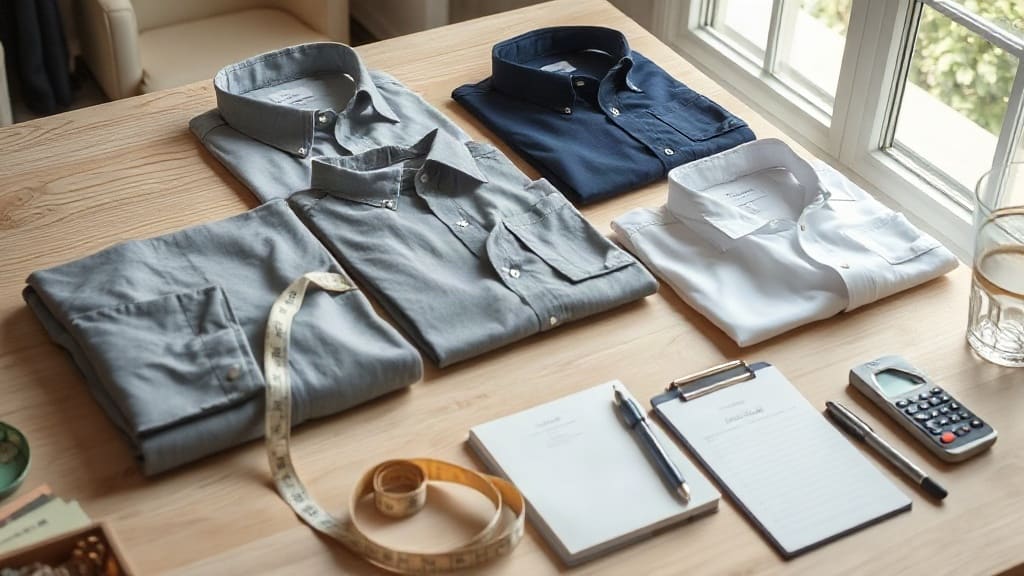
When you're sourcing custom premium shirts for your team, event, or brand, one number often gets overlooked: CPS. Short for cost per shirt, CPS is the real price you pay for each garment after factoring in everything from fabric to decoration. Ignore it, and you might blow your budget or settle for less quality than you expected. Understand it, and you can negotiate better, plan smarter, and end up with shirts people actually want to wear.
I've been on both sides of the table, ordering shirts for a 50-person startup and later managing bulk orders for a retail brand. The lessons were the same: the sticker price is just the beginning. Let's break down what drives CPS for custom premium shirts, how to calculate it accurately, and how to get the most value without sacrificing quality.
What Exactly Is CPS in Custom Apparel?
CPS stands for cost per shirt. It's the total amount you spend divided by the number of shirts you receive. That includes the base garment cost, any customization (printing, embroidery, tagging), shipping, and even rush fees if you're on a tight deadline. For example, if you pay $1,200 for 100 shirts, your CPS is $12. But if you add $200 for shipping and $150 for a last-minute upgrade, your true CPS jumps to $15.50.
Why does this matter? Because comparing quotes based on unit price alone is misleading. A supplier offering a $10 shirt might charge extra for setup, while another at $12 includes everything. Knowing your CPS lets you compare apples to apples.
Why Premium Shirts Change the Equation
Custom premium shirts aren't your average promotional tees. They often use ringspun cotton, tri-blends, or performance fabrics that feel softer and last longer. These materials cost more upfront, but they also hold up better after repeated washes, which can lower your effective CPS over time. If your team wears these shirts weekly, a $20 premium option might actually cost less per wear than a $8 basic tee that fades after five washes.
Key Factors That Drive Your CPS
Several variables influence CPS. Understanding them helps you make trade-offs that align with your goals.
- Fabric and construction: Premium cotton, organic blends, or performance fabrics cost more than standard cotton. Details like reinforced seams or side vents add to the base cost but improve durability.
- Decoration method: Screen printing is cost-effective for large orders, while embroidery or direct-to-garment (DTG) printing can be pricier per piece. The number of colors and print locations also matters.
- Order quantity: Most suppliers offer tiered pricing. Ordering 50 shirts might yield a CPS of $18, while 500 shirts could drop it to $12. The setup cost gets spread across more units.
- Turnaround time: Need shirts in three days? Rush fees can add 20-30% to your CPS. Planning ahead usually saves money.
- Shipping and taxes: These are easy to forget. Factor them in early to avoid surprises.
I once made the mistake of ignoring shipping on a bulk order. The quoted CPS was $14, but after freight and customs, it ballooned to $19. Now I always ask for a landed cost estimate.
How to Calculate Your True CPS
Grab a calculator and follow these steps:
- Add up all costs: Garment cost + decoration + setup fees + shipping + taxes + any rush charges.
- Divide by the number of shirts: This gives you the base CPS.
- Adjust for waste or extras: If you expect 5% defects or need spares, factor that in. For 100 shirts with 5 spares, divide by 95 to get a realistic CPS.
Let's say you order 200 premium shirts at $9 each, pay $300 for screen printing, $100 for shipping, and $50 for setup. Total cost = $2,250. Your CPS is $11.25. If you add 10 spares, you're really getting 190 usable shirts, so your effective CPS is $11.84. That's the number to use for budgeting.
Tools and Templates
You don't need fancy software. A simple spreadsheet works. List all cost components in one column, quantities in another, and let a formula calculate CPS. I keep a template that automatically updates when I change quantities or add fees. It's saved me from overspending more than once.
Strategies to Lower Your CPS Without Cutting Quality
You want premium shirts, but you also want a reasonable CPS. Here's how to achieve both.
- Order in bulk: If you can forecast your needs, ordering 6-12 months of shirts at once can significantly reduce CPS. Just ensure you have storage space.
- Simplify decoration: One-color prints or a single embroidered logo cost less than multi-color, multi-location designs. Sometimes less is more visually, too.
- Choose standard colors: Specialty dyes or custom Pantone matching add cost. Stick to popular colors that suppliers stock in volume.
- Negotiate: Don't be afraid to ask for a better CPS on large orders. Suppliers often have wiggle room, especially if you're a repeat customer.
- Plan ahead: Avoiding rush fees is the easiest way to keep CPS down. Give yourself at least 3-4 weeks for production and shipping.
On a recent project, we switched from a two-color front print to a one-color left-chest logo. The CPS dropped by $2.50, and honestly, the shirts looked cleaner. The team loved them.
Common Mistakes That Inflate CPS
Even experienced buyers slip up. Watch out for these pitfalls:
- Forgetting about setup fees: Screen setup can be $20-$50 per color. On small orders, this can double your CPS.
- Underestimating shipping: Especially for international orders, shipping and duties can add 30% or more.
- Not accounting for spoilage: Printers sometimes make mistakes. Order 5-10% extra to cover defects, but remember that raises your effective CPS.
- Choosing the wrong decoration for the quantity: Embroidery is cost-effective for small orders (no setup), while screen printing wins for large runs. Mixing them up can inflate CPS.
I learned the hard way when I ordered 25 embroidered polos. The CPS was $28, but if I had chosen screen printing, it would have been $18. The lesson: match the method to the order size.
Real-World Examples: CPS in Action
Let's look at two scenarios to see how CPS plays out.
Scenario 1: Startup Team Shirts
A 20-person startup wants premium tri-blend tees with a small logo. They order 50 shirts (including spares) at $12 each, pay $100 for screen printing (one color), $40 for shipping, and no setup fee (promotion). Total cost = $600 + $100 + $40 = $740. CPS = $14.80. They could lower it by ordering 100 shirts, but cash flow is tight. They accept the higher CPS for now.
Scenario 2: Corporate Event Giveaways
A company orders 500 premium polos for a conference. Base cost $10 each, embroidery $3 per shirt, shipping $200, setup $50. Total = $5,000 + $1,500 + $200 + $50 = $6,750. CPS = $13.50. Because they ordered in bulk, their CPS is lower than the startup's despite the embroidery. They also negotiated a 5% discount, bringing CPS down to $12.83.
These examples show that quantity and decoration choices heavily influence CPS. Always run the numbers before committing.
Frequently Asked Questions About CPS and Custom Premium Shirts
What does CPS stand for in custom apparel?
CPS means cost per shirt. It's the total cost of your order divided by the number of shirts you receive, including all fees and shipping. It's the most accurate way to compare quotes.
How can I lower my CPS without sacrificing quality?
Order in larger quantities, simplify your decoration (fewer colors, one location), choose standard fabric colors, and plan ahead to avoid rush fees. Negotiating with suppliers also helps, especially for repeat orders.
Is CPS the same as unit price?
No. Unit price is just the cost of the blank garment. CPS includes decoration, setup, shipping, taxes, and any other fees. Always ask for the all-in CPS to avoid surprises.
What's a good CPS for premium custom shirts?
It depends on the shirt and decoration. For a basic premium tee with one-color print, a CPS of $10-$15 is common in bulk. For embroidered polos, expect $15-$25. Compare quotes based on the same specifications.
How do I calculate CPS for a mixed order?
If you order different styles, calculate the total cost of all items and divide by the total number of shirts. For more precision, calculate CPS per style by grouping costs accordingly.
Understanding CPS gives you control over your custom premium shirts budget. Whether you're outfitting a team or creating branded merchandise, knowing your true cost per shirt helps you make smarter decisions and get the most value from every order.